Keywords:
Experience: implies perception and awareness (a bodily and not only mental activity)
Complexity: implies process, living systems, synergy, homeostasis (and not just overwhelm). A focus on the whole that is greater than the sum of its parts. Integration rather than differentiation. Both/and instead of either/or.
Together: a form of intersubjective complexity—social, emotional, and sensual— it implies a meeting of both minds and bodies in a real econiche, a specific and generative environmental context that is a necessary consideration. We are together with ourselves, with each other, and with the environment and all that is alive within it.
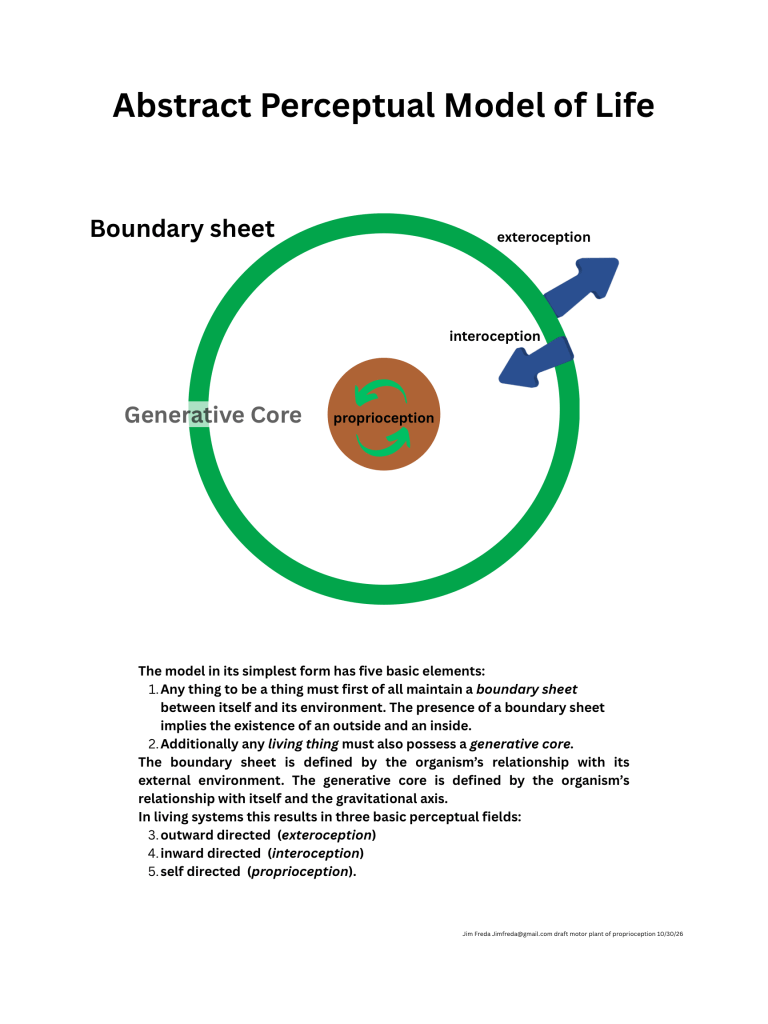
Perceptual mechanics describes the basic “qualia and quanta” of the experience; the mechanics are what make it real and actionable.
Two Major Perceptual Systems: two basic perceptual fields in all living organisms, especially vertebrates like ourselves.
1. a boundary system in both brain and body (a boundary that possesses an outside and an inside) by which we deal with the external environment, including the social emotional environment and anything we consume, like air food and water. Allostasis and physiological homeostasis
2. a core system a generative core structure in both brain and body that provides identity, self-awareness, and physical homeostasis. Most isolated from external factors.
Three sensory motor systems
These two major fields or aspects of an organism (the boundary sheet and the core) result in three distinct sensory motor systems because the outer boundary surface has both an outside and an inside.
- Outside: Exteroception—analysis and intellect. Locus: cerebrum and extremities, five senses. The system by which we perceive and relate to the outside world (extero-ception). Well understood scientifically and experientially.
- Inside: Interoception—visceral and emotional. Locus: insula (deep cerebrum) and visceral organs. This system processes elements that enter into (intero-ception) the organism from the outside. Well understood scientifically and experientially.
- Core: Proprioception—postural, tonic, meditative. Locus: axial anatomy (the “deep core”), cerebellum. This is a physical system of coordination and integration built around the generative core and gravitational axis. Least well understood scientifically and experientially. Most important for our grasp of complexity as a whole rather than as numerous dissociated parts.
Mechanics: how the system moves in time and space and so how we experience it physically.
Boundary system:
exteroception (other awareness, objective reason) is well understood scientifically and experientially. Dynamical, conscious, volitional. Visible, observable, verbal. (Dynamic in this context refers to large and sudden or discrete actions, also referred to as phasic, The opposite of this kind of activity is called tonic or postural and is a characteristic of the deep system, in both the brain and the body.)
The well understood movements of bodies in space and the extremities or limbs of bodies, with their surface sensory organs. We describe these movements through the science of kinesiology and they are very familiar.
We understand the function and structure of the forebrain and have a subjective, clear sense awareness of things that happen in our brain or in our head, like taste, smell, vision and hearing. We experience the form of touch that is present in the boundary system in our skin unambiguously as an externality. This system is the source of objective evidence of the world.
We experience complexity in this system in what is called allostasis, the conscious and active adaptive movements of the body and mind in the social and physical environment. This system makes frequent errors.
Interoception is also well understood but as in inner system is less visible, volitional, and dynamic. This is the inner surface of the boundary sheet of the organism: the tubes and organs of the guts. We are immediately consciously aware of this system as our breathing, our heartbeat, our digestive tract, and etc. Some parts of it like the immune system are much less available to conscious awareness. We have recently studied its representation in the brain at a fairly high level of detail (the insula, Bud Craig, “How Do You Feel?” 2015). Sensory experience in this interior system is still largely conscious but is less clear than that of the outer surface of the organism.
We experience complexity in this system in what is called physiological homeostasis, the largely unconscious and automatic adaptive actions of the internal organs. This system is adapted to processing those elements that enter into the organism from the outside and so is far more constrained in scope than the surface system. We can experience disruptions in this system that can be catastrophic but it is more automatic and subconscious than our experiences in the surface system. This system is a locus for emotional activity (like gut feelings) but all three systems are involved in cognitive and emotional function in different ways. Much of somatic psychology is focused on this system and incorrectly generalizes it to encompass all internal sensation and awareness.
Core system: proprioception (self-awareness this is the least well understood system in science but we practice this kind of core awareness in a variety of different forms in different cultures and historical eras, including yoga, tai chi, meditation and all the variety of the tonic movement arts. This is the tonic system in both the brain and the body. This system is foundational. Tonic or tonus refers to something like the base play player in a band, as opposed to the lyrics and the melody and other instruments which are much more variable and also which define the music more explicitly. The tonic system like the cerebellum is an implicit system. The cerebellum has been called a brain for an implicit self (Masso Ito). The tonic system is long, slow, and continuous and provides the foundation for all of the dynamical activities the organism engages in like movement in the environment and any kind of active reaction. In the body the tonic system is the postural system and is located in the core of the skeletal structure, deep and close to the joints and bones, where it’s stabilizes, grounds, and centrates the body.
The skeletal anatomy of the postural or tonic, core system is simple and intuitive and consists of the vertical axis of the body with its major junctures and bony landmarks. We do not regularly recognize the presence of the system and its function is almost entirely subconscious. We certainly have access to it in meditative and movement practices.
It’s kinesiology or functional mechanics, the way that the axial system moves, is quite different than what we normally think about as the way that we move in the outside of the body and the extremities. This is worth exploring but can be perceived as the movement patterns of: centration, balance, stabilization, pressurization, grounding, left, and helical turning movements. Again we are intently familiar with these kinds of tonic micro movements but they are much less well understood in science. These movements are synergistic or coordinative and work together whereas the movements of the extremities in the surface system are opposites: we either flex or extend, abduct or adduct, but not both together.
The “brain” of the system is the cerebellum and its sensory organs are also unique: the foremost sensory organ of proprioception or self-awareness is the muscle spindle. These are unusual packets (spindles) of different nerves containing their own muscle fibers (3-5). In this way the muscle in the system is itself a sense organ as well as an action organ, resulting in what has been called the “muscle sense”. This is a fairly radical way of looking at ourselves.
These muscle spindles are located deep in the sensitive inner skin or fascial membranes that wrap around the many smaller compartments of muscles and provide feedback on the movement and pressures of the deep system as it acts against itself.
Very different sense organs provide the sense of touch that we are aware of in the surface system. The deep system reports to the brain only the pure self-stimuli of the body’s own movements against itself and gravity. It is difficult to understand how this is possible because our awareness is so dominated by our sensory perception of the visible movements of our limbs that we consciously control and by which we relate to the outer world. We associate our sensory awareness with all the things that we see, smell, taste, and hear and touch through our five senses. However this deep sensory motor system is the intrinsic source of pure self awareness.
The self is our primary experience of complexity.
This system is especially important for our relationship with complexity because it is what enables us to grasp complexity as a whole, rather than as a variety of separate parts. This happens in a very palpable physical way in the core of the physical body when we undertake the slow tonic micro movements of practices like meditation and yoga. It happens in the brain in the second or hind brain, the cerebellum, with its very distinct and uniform architecture. The cerebellum is a very large organ of the brain that is separated from the rest of the brain by a leathery tentorium, the same material that divides a hemispheres of the brain. The cerebellum has a single consistent architecture and is understood to function as a transformer and as an internal model, which regulates both postural activity and cognition. It is the cerebellum that internalizes patterns of movement, behavior, and thought so that they become automatic. It is the cerebellum that provides the gateway to that profound and somewhat mysterious aspect of our being that is related not to the visible and objective evidence of the outside world but to the gravitational axis, the energetic or generative core at the heart of all living things.
Conclusion
We experience complexity together as perceptual beings with specific sensory motor features. In so far as complexity implies something that is transcendent and integrative it is most important for us to understand the role of our deepest system, the core system of proprioception or self-awareness and how it operates both as a sensory and a motor system.


Leave a Reply