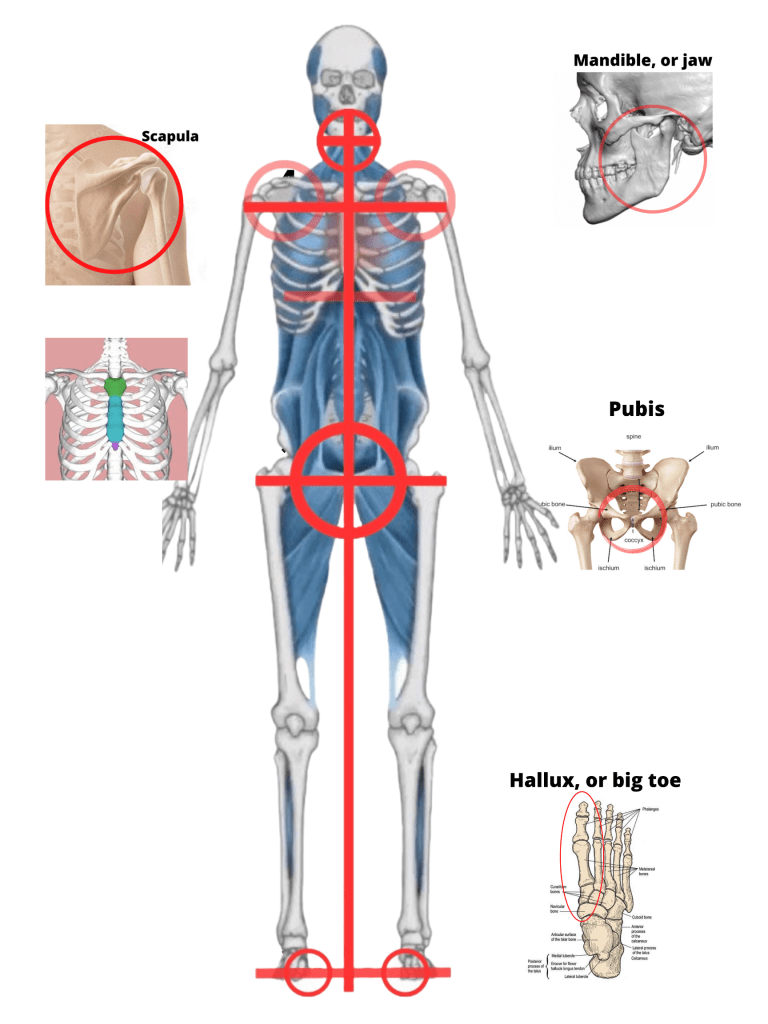
The anatomical landmarks of embodied cognition are no less self evident than the falimiar anatomical landmarks of mental cognition. Our different sensory organs, the eyes, ears, mouth and skin, our hands and feet, our torso and our head are universally familiar landmarks for self awareness in the surface system. These are self evident to the animal mind and although we can name them and dissect them doing so is not required to understand them meaningfully. We rarely question them, in fact, and readily validate and value the sensory and motor inputs they provide to us and by which we discriminate the truth, the precision of our understanding.
Through the surface system we come to know about the other creatures and the environment we live within as it is constantly changing. From the surface system we adapt to and change the environment we are within. This is the simple surface system of self awareness we all take for granted and by which we identify ourselves. Perceptually this is the system the organism possesses to be aware of the outside world and our position and actions within it.
However we’ve recognize implicitly that there exist other forms of awareness than this obvious superficial one, other perceptual systems in the neurophysiology of the human body. These are ways of looking at life itself and looking at ourselves fundamentally different than the physical and mental qualities of the surface system. These different systems require to different degrees a transformation or shift in the location of our attention and awareness. There is a great deal we can do working just from the surface system and seeing things from the outside. However there are certain very important functions that are only possible when we perceive things from the inside. It is possible to include in what we view as the surface system of the organism both its outer and its “inner” surface, which literally corresponds to the viscera or guts. In a cell it would be the cytoplasm.
When we think about the inner system consisting of the heart and blood and breathing, the guts and digestion as well as thirst and elimination, we know ourselves to be able to perceive and participate in the actions of the system. We experience the many different separate systems, each with their specific location in the body, but we are also aware of the system in some measure as a whole, a functional unity. The guts are connected as a single system, for example, from head to tail. This clearly endows us with another system of self-awareness, but it is important to qualify that and recognize that when we experience awareness of our guts, our heartbeat, our breathing, etc., that level of inner awareness generally lacks the same sort of intentional, conscious agency and sense of identity that we find in the mental sense of self in the surface body. The inner field is a subsystem not only of the body as a whole but of the service system to which it is connected.
Combined, the two sides of the surface of the organism, it’s outer and inner surfaces, possess two very different systems of perception with two very distinct sensory motor architectures. This is exteroception and interoception, two sides of the same surface field, one on the outside and one on the inside. But in the gentle passage of time, perhaps standing still as the wind and clouds provide encouragement, we begin to recognize that we have not yet penetrated into the deep field. Beyond the outside and the inside there is a third field, a second major field, an axial core which is the true complement to the surface field as a whole. Beyond the outside and the inside their lies the generative core and this is an essential property we find in nearly all living organisms, except the most simple, from the seed and the plant or animal cell, to the chordate body plan of the embryo in its earliest stages, and of course the entire phylum of vertebrate animals. It exists in apples and flowers and the planet itself. Despite our confidence in our grasp of the inner field, it begins to appear to us undeniably and insurmountable that something is missing from our model of life. There is no other way to explain the errors in judgment we are making as a civilization. Beyond the outside and the inside there exists within us a purely self-referential postural core, the energetic central channel, a gravitational axis, a field of pure muscular and skeletal self-awareness. It is self evident but its comprehension is an act of great Consilience.
As we condider these things, we begin to recognize the somewhat startling fact that we are behaving under an injunction that prohibits our recognition and attention beyond the surface fields of outside and inside. The core has been shamed. Everyone wants to believe that what we call the inside, interoception, the gut, constitutes the entire inner experience of the self. Since the word was carefully constructed in 1906 and more recently redefined, in the rush to understand embodied cognition, we have decided that this inner sense of the guts must be everything inner. In this view, there is outer sense and there is an inner sense and that is the sum totality of it, we believe. But by generalizing the technical term interoception it loses its neurophysiological and anatomical specificity. It loses its meaning.
This is because we are using the term “inner sense” in an attempt to cover up what is missing from the model, its deep core. While the deep system necessarily functions constantly within whether we explicitly recognize it or not, it is difficult to give it sustained conscious attention unless we are familiar with its specifics, its basic anatomical features. The reason for our ignorance is not that the system is insensible and impossible to be aware of. Quite the opposite is true. However we have not had the necessary conceptual tools to see the system for what it is. To see the axis of the body as a functional unity required the development across the last century and a half or so of an entirely new set of conceptual tools, an actual physics of life.
However in so far as the system itself is intuitive and self evident, simply recognizing the landmarks of its bony anatomy can provide enough sensory motor metastability to trigger conscious awareness of it. Without a simple, self evident familiarity with it it is very difficult to conceive of the deep field as a functional unity with its own distinct and real agency in the body. We don’t see something as meaningful when we don’t appreciate the fact that it is a thing, a functional unity, a self controlling system. This is the postural core of the body and it operates independently of and by a different set of physiological and biomechanical rules than the surface system.
What is startling about what we understand today is that the brain of the system is the cerebellum, the second or “hind” brain, and this goes a long way to explaining the different experiential parameters of embodied cognition. Not the visual, verbal, explicit cognition in the surface sheet and not the chemical and emotional cognition of the inner surface, but the slow, steady, gentle and continuous tone of the deep postural core.
It is possible for the two brains to operate simultaneously because they are orthogonal to each other. One goes up and down while the other goes across, one provides the melody and the other provides the rhythm. One reaches outward mentally and physically, apart from the self, out into the world and into the future. But the other reaches only inward, purely reaching for the self. This system in a very real way is constrained only to hugs itself, to get a grip purely on itself.
It makes sense when we think about the architecture of the core system, which is very different from the surface system and the guts. Like the surface system it is skeletal, a full body-wide integrated system. But unlike the surface system it is the core, more than just the backbone, a full body axis, a singularity. It is when we recognize this self evident skeletal anatomy, it’s self evident bony landmarks, that the computational identity of the missing field comes into focus.


Leave a Reply