
One of the questions we have to ask ourselves in the current context is whether our best judgments and decisions might not be fundamentally and seriously affected -and even undermined- by our own unconscious and internalized disassociation, delusion, and denial.
We consider ourselves to be highly educated and authoritative experts on the nature of reality at the same time as we are killing ourselves and the planet through our ridiculously unsustainable lifestyles.
We are clearly missing something fundamental.
It is about time that we came to our senses. There is broad agreement that what we need is a fundamental shift in perspective.
We are experiencing a profound civilization level paradigm shift — a breakthrough in our understanding of complex living systems. What this really means is a shift in perspective from top down control and power-over to a grasp of bottom up coordination and power-with. This is coming from a deep study of living systems, ecology, biophysics, neurophysics, and many fields of culture, like the movement movement.
For us personally it means a shift from identifying our wisdom as a product of our intellect located in our heads to a richer and organic form of insight that comes from within, the rich animal intelligence we possess in our bodies.
This is what it means to come to our senses. The senses that we need to cultivate are not our external senses: sight, smell, taste, hearing and touch. We know ourselves from the outside in and we know the world from the outside in through the five senses. But these are by no means are only sensory systems.
The shift that is occurring is that we are beginning to comprehend life from the inside out. We know ourselves by looking at our bodies from the outside in. We have intimate and sensitive awareness in our outer skin: it tells us who we are, what size and color, how big or small, and through our outer skin we can feel things like hardness and softness, heat and warmth and touch the world around us.
All of this is very familiar and very comfortable and indeed these external five senses are the basis for the evidence of science and all the claims of reason and common sense.
There is a formal name for this system of external senses. It is called exteroception. There is another very complex system of sensory organs located inside the body. These senses of our inner self are collectively called interoception and they make up our interoceptive sensory motor system.
Our movements with our limbs and our bodies through the world are guided by our five external senses. Our deeper inner lives, including not just our physiological functioning but our emotion, behavior patterns, memory, and intuition are guided by our internal senses, our interoceptive sensory motor system.
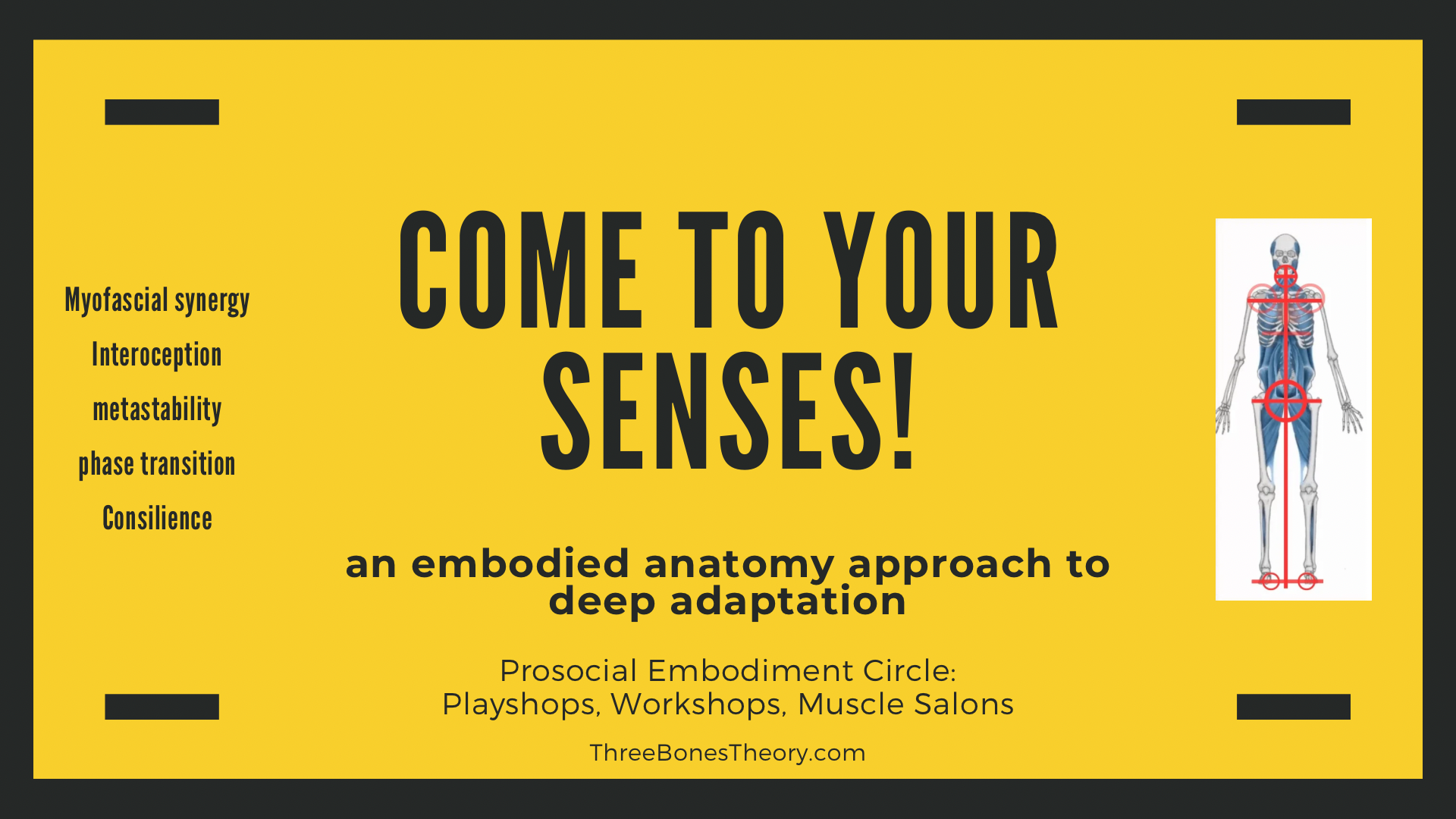
Where we know ourselves from the outside in because of the properties and physical appearance of our outer skin, our inner life also is dependent upon a similar system of membranes, called fascia. It is the rediscovery of fascia that is perhaps the single greatest insight of the current paradigm shift. Fascia is a complex layered system of tissues that are highly sensitive and are involved in the movements of every aspect of our inner life, from the movements of cells and organs to that of muscles and bones. The connective tissue matrix, our fascia, is complex and layered, somewhat like an onion.although it is complex and highly sensitive there are major pathways that simplify our conscious self-awareness. The most important of these is our axial line, a myofascial synergy called the deep core.
Our internal movements are often micro movements. Micro movements are the specialty of the postural system, which. is the core of the entire Interoceptive sensory motor system. The postural muscles are defined by their depth, their closeness to the bone and the joints, and by their self directed and self regulating behaviors. The postural system is self-directed, self balancing, and self-aware.
While we relate to the conventional outer system of muscles, called the dynamic system, easily and consciously, the postural system is somewhat more obscure. It is less visible and highly automatic. But this does not mean that we do not know it or feel it. Of course we do but we we relate to it with a different kind of consciousness and a different part of our brain. This is the perceptual shift that we need to deal with the metacrisis.
The postural (or autonomic system) of muscles has its own metabolic pathway, distinctive neurology, and even specific circulatory requirements. It is distinct from the external and subjective exteroceptive sensory motor system and the larger more superficial dynamic muscles that we are most familiar with. But these deep inner muscles have never been hidden from us. The opposite is true.
Located at our very core, intertwined with the richest neurology, in many ways these are the most intimate, sensitive, and active areas of our body. Throughout human history we have always found simple and intuitive ways to relate to this inner system, whether through yoga or tai chi and many other forms of meditation, dance or movement arts. There is indeed a different protocol for accessing this part of ourselves, but it is natural, intuitive, and even easy once we get beyond the habits of mind, prejudices and biases that we have over developed so powerfully throughout the modern era.
This is the perceptual shift that the metacrisis requires.
What is missing was always already there, located at our deepest core, actively supporting us and holding us together from the inside out. It is this deep core system that provides the centration and grounding, the balance and structural stability, the creativity, intuition and psychological resilience that we need now more than ever. This part of our bodies has always done this and always will, and struggles to continue despite the physical immobilization, dissociation, trauma, and abuse that we experience.
The perceptual shift, the civilization level paradigm shift, is the emerging self-awareness we are finding of this part of ourselves. Because this is such a fundamental part of our experience our inner red discovery takes as many different forms as there are people and places in the world. But through it all we see a consistent pattern and this pattern is dictated by the physical structure, needs and behavior of the body itself. We can name this inner core the interceptive sensory mortar system. We can describe it as our axial line or our deep core. We have thought of it before as energy meridians or the chakra system. But before today we have never had a clear anatomical grasp of it. This is a major part of the paradigm shift, the scientific rediscovery of our fascia, our connective tissue matrix.
This is a major revolution in anatomy and is ushering in a new era of synergistic rather than reductionist anatomy. It is fundamentally changing the way we see our own bodies, ourselves and life itself.
The philosophical and scientific implications are far reaching but the most important realization is the one that we have in our daily lives — by knowing ourselves better on the inside. The involves a perceptual shift and activates a very different part of the brain than just the intellect. It is a different form of self-awareness and complements rather than contradicts what we already possess. Interoception is a preverbal and right hemispheric, integrative and holistic cognitive function. It is all these things and more but in the end is simply a matter of coming to our senses. This does not require extensive technical training or sophistication. We can use all of these big words and fancy arguments but they are not required. Change happens from within. Indeed animals and children master this part of their bodies without education or even language. It is intuitive and automatic, instinctive and natural.
But what has been missing is a conscious awareness and appreciation of this part of ourselves. We have not had a clear anatomic grasp of its location, constituent parts, and its highly integrated functioning. We have been so focused on cultivating our intellectual capacities that we have repressed, neglected and rendered dysfunctional this central and important part of ourselves.
Being able to name the interoceptive sensory motor system is the radical ingredient that takes us into the larger domain of metacognition and metastability.
When we come to our senses we begin to see ourselves, each other and life itself from a fundamentally different perspective.
 Three Bones Theory
Leave a Reply