How to Heal the Social Fabric From Within, Not From Above.

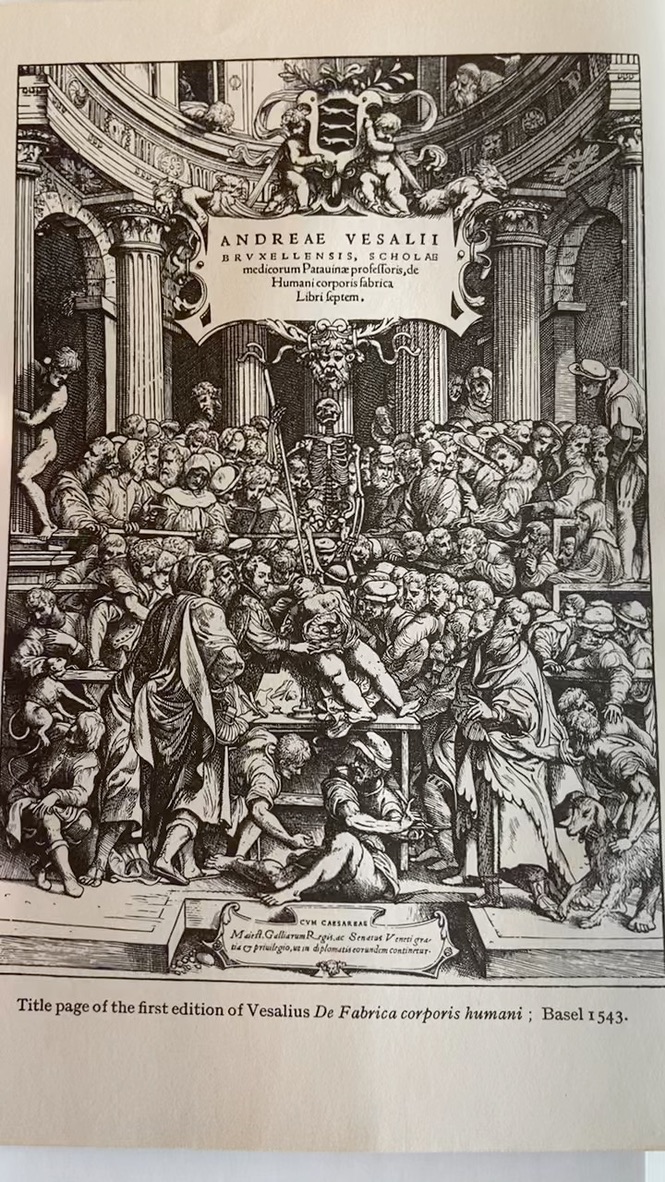

”Fabrica” was the name of first modern anatomical text, by Andreas Vesalius, published in 1543. This was the same year Copernicus published his astronomical text, “Revolutionibus.” Fabric and all the areas of complex living systems is the domain of the somatic tradition of natural history. Anatomy, not geometry, is at the living heart of this sector of science.
The social fabric evolves organically and reflects the customs, beliefs, and values of a community. It is not an intellectual and abstract phenomenon that we can build digitally, in absentia. The social contract is not written in words, on paper. It is written in our behaviors and beliefs. The social contract is written in the body. It is reinforced through experience and the give and take that happens naturally in a healthy system.
To heal the social fabric we must start from within. No matter how many policy papers we write, no matter how clever are our insights and arguments, the social fabric is still located in our bodily behaviors and in genuine physical contexts and relationships. Experience of situated, embodied and interpersonal life is the basis of the social contract.
The social fabric begins within us and for this purpose we propose the idea of social fascia. The social fascia only exists in the context of the whole. It is like nature and exists freely for the good of all. No one owns it philosophically or legally. The rediscovery of fascia as an important body part is one of the most exciting and impactful new scientific discoveries of our era. It is a paradigm shift in many fields, from anatomy and medicine to psychology, neuroscience, and biophysics. It completely changes our understanding of the mind and the body.
Fascia is our connective tissue and our major source of inner self awareness. Our awareness of the outer world and our own body on the outside is called exteroception and we are very familiar with it. It is the basis for all the evidence of science. Inner awareness of our bodies is called interoception. This includes postural sensory motor system as well as many other physiological systems, but it implies an inner, interoceptive sense of self and a different form of cognition.
The recent insights into the function and physiology of fascia make it a good candidate to think in new ways about the social fabric and the unwritten, implicit social contract. Fascia is not only a tremendously exciting and new source of neurological and biomechanical insights, it is like an inner skin by which we know and feel ourselves. In this sense it is preverbal, animal, and familiar. Together with the muscles, in the form of myofascial synergies, this is the most easily accessed part of the interoceptive sensory motor system. We are meant to naturally and intuitively have this inner awareness.
The social fabric connects us in a dynamic, interactive system. If anything is, this is the Gaia intelligence—and it is a right hemispheric cognitive function. We hypothesize that it is the solution to the left hemispheric imbalance that is so apparent today. The rapid rise and total dominance of technological communications systems has exacerbated this physical, psychological, social and environmental dissociation. Dissociation is integral to modernity, modern reason and, modern urban lifestyles, and modern industry.
Our body contains a fundamental biopsychosocial process that seeks homeostasis. It is working to correct the imbalances it faces. This is why change starts from within and the idea of social fascia matters. We propose Prosocial Embodiment because e have to address the social fabric from deep within. Merely intellectual and mental superstructure has little impact at this level of reality.
Technology has resulted in an exaggerated and accelerated development of bias in our perceptual system. This happens chronically, over time, and beneath the level of our conventional awareness. Because of screens we all increasingly interact with a dissociated and abstract symbol system, rather than real people who are actual stakeholders in their local ecosystem. This results in a deterioration of the social fabric itself. It is a process that we are not readily aware of. Like cultural evolution, it happens within and between people over large distances and long periods of time, even generational cycles. It is understandable that we cannot see it until it is already a crisis. Perhaps this is why apocalypse in the original Greek meant revelation.
Where to we start to fight back? Within ourselves, of course. Our own inner selves is the biopsychosocial revelation that we each need individually and together.
The social fabric is in our bodies, not only our brains. When dissociated, we tend to have tenuous, disappointing and unproductive interactions both within ourselves and with others and the earth. We can create new theories and new plans, but if they remain mental they have little real weight. They are dissociated. To address this, we need to lift the burdens of fear and shame, and share our bodies and our inner experiences together. At some point the fascia, our innermost self, becomes social. This is what we are seeking experientially, socially, and theoretically at Prosocial Commons.
Our commitment at Prosocial Embodiment is to highlight the seams that bind us together. We start with the postural system and the deep core of our own bodies. The deep core system is a real and active system of sensitive muscles and nerves that functions within us continuously as a bodywide synergy. It is an integrated whole. It is what centers, grounds, stabilizes and coordinates our body. We haven’t had the ability to define, discuss, and access the postural system at this level of detail and familiarity until now.
Without this system that already is at work in each of us, we could not stand up and or even sit up. It is literally what holds us together from the inside out. This radical new anatomy, the anatomy of the interoceptive sensory motor system, is where we start asking the question: How can we restore the social fabric in a safe, joyful, healing, and intentionally Proscial way:
Join us at Prosocial Embodiment.

 Three Bones Theory
Leave a Reply