Three Bones Theory
Three bones theory states that there are three major, prominent bones arranged in a system on the axial line of the front of the body. These are the jaw, the pubic bone, and the big toe or what is called the first ray of the foot. Each bone is located at the center of a major junctures of the body. These junctures are located at either end of the spine and where the feet meet the earth.
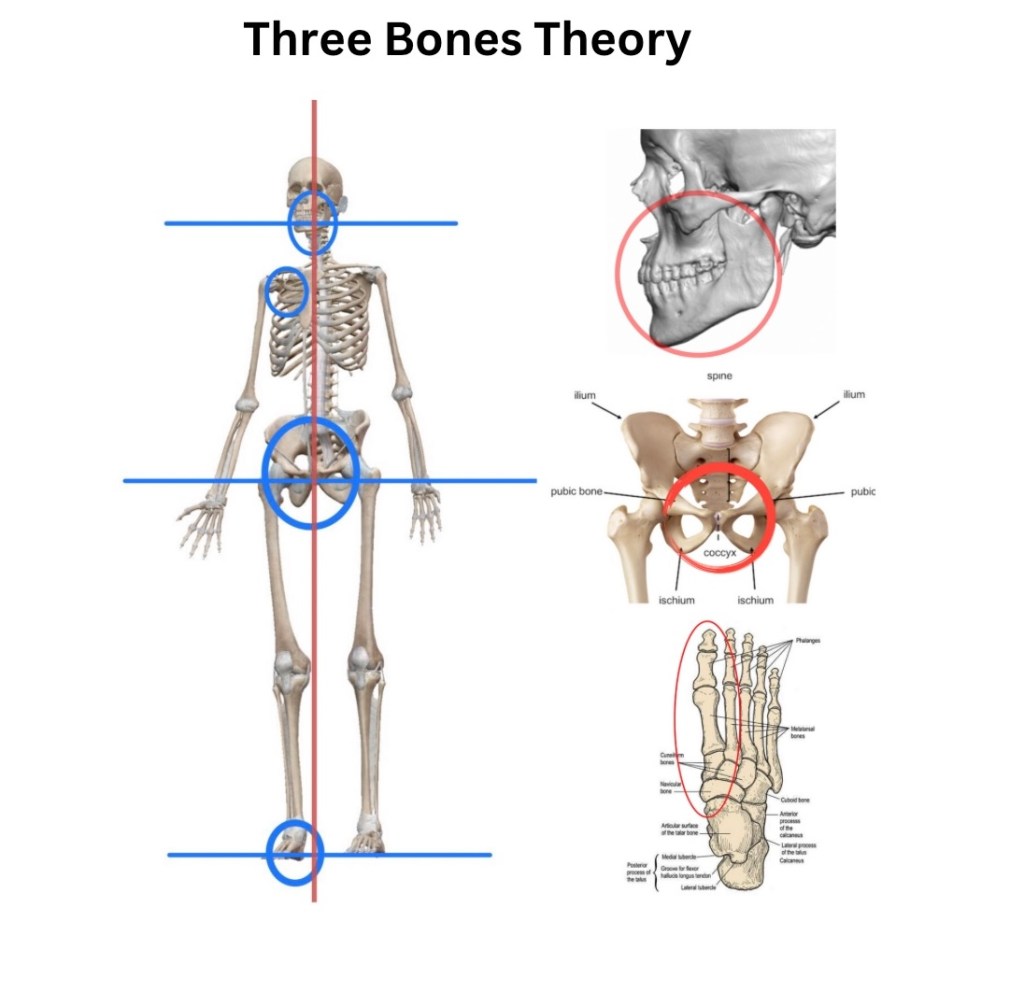
The bony servomechanisms are shaped like grips, levers, or handles and function as servomechanisms or bony affordances organizing the arrays bones, muscles and other tissues that radiate out from them. These bones are the coordinative centers of our structure. These bones are where we focus our attention in order to participate in the coordination dynamics of our body.
This is the axial line of the body. We can understand it as a single body part that acts as our postural core. It is a powerful myofascial continuity called the deep front line or deep core by Thomas Myers. This is effectively a newly discovered body part that consists of a single very complex myofascial continuity that binds us together from the inside out and from tongue to toe.
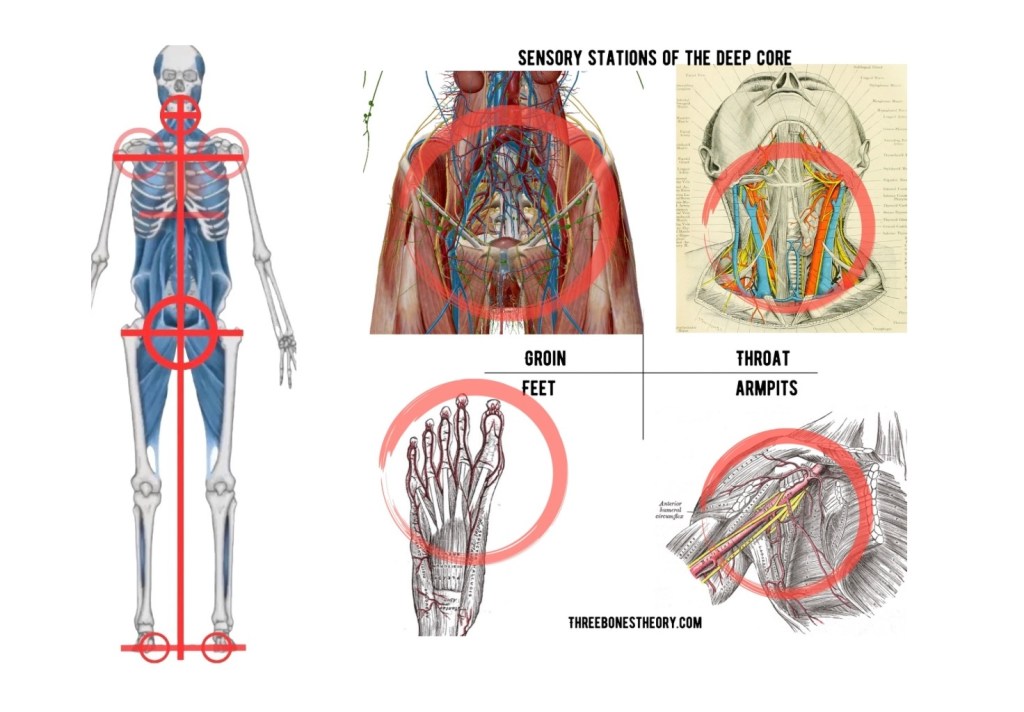
Three bones theory further states that each of these junctures is a very special area called a sensory station. These areas are the major biomechanical junctures of the body, consisting of multiple joints and complex arrays of muscles. Built around the spinal column, these are not only centers of biomechanical and postural self organization. These areas are also extremely diverse collections of sensory organs.
These are the major sensory stations of our body. We are meant to feel ourselves primarily in these areas. Like the navels of an orange the mouth and the groin are where the deep core emerges to the surface. It does so in a profound cornucopia of sensory and communicative organs. These are areas that invite awareness and attention very strongly.
This is where we know ourselves and the bones at the center of these sensory stations are feedback and control devices. What this means is that the structure itself tells us how to operate it. The owners manual is contained within the structure, in the form of our animal intelligence, and we know it when we participate in these areas consciously. There is no better example of conscious evolution.
The postural system is a largely subconscious and automatic system. It operates itself. In this sense we can consider it to be self aware. It involves the direct integration of multiple complex sub-systems and extends through the entire body from head to toe. This is our axial line and it has a mind of its own. We can consider the deep core the locus of our animal intelligence.


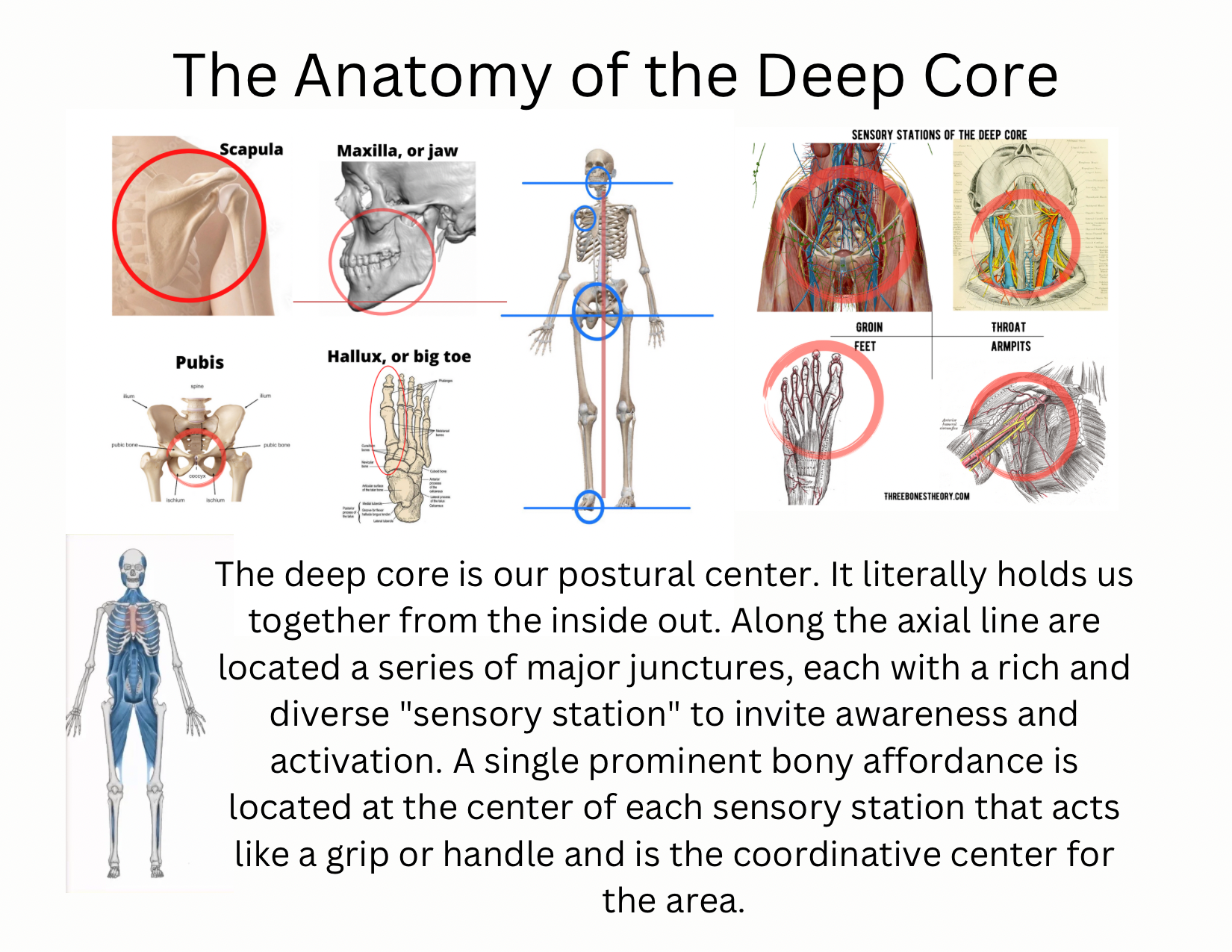
A fourth bone is the scapula, where the arm attaches to the body on the back of the ribs. The scapula is the center of an array of 17 muscles, by which it attaches itself to the body and organizes the movements of the arm. The scapula is a grip shaped bone that perfectly fits in our hand. When we operate our hand consciously there is a symmetrical awareness located in the scapula at the other end of the system. This dual correspondence ensues that we properly self organize the movements of the arm and allows us to avoid the most common shoulder problems. This is a good example of a bony servomechanism or affordance.
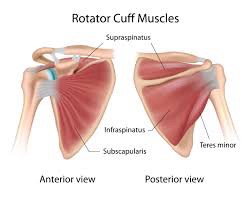
The 5 intrinsic muscles of the scapula act like a hand whose fingers are wrapped around the shoulder joint and form the rotator cuff. They do this in much the way your fingers wrap around a door knob in order to grasp it. In this way the scapula is the coordinative center of the shoulder joint. It also powerfully influences the rib cage and stabilizes the torso.
Each bone acts as the coordinative center for its area through the muscles and bones and other other tissues that radiate out from it.
—
Three bones theory states that there are three prominent bones located on the axial line of the body. These are the jaw, pubic bone, and big toe. These are each located at the center of the three major junctions of the body—at either end of the spine and where the feet meet the earth. Each bone acts as a coordinative center for the area, through the muscles and bones and other other tissues that radiate out from it. Each bone is shaped like a grip, lever, or handle and functions as a servo mechanism or bony affordance in a feedback/control relationship with its anatomical region and the external environment. The system is automated and self organizing. The presence of these bony affordances means that we are meant to intuitively and easily participate in these major junctures.
This is an anatomical system of the coordination dynamics of our deep core, our animal intelligence. This embodied self-awareness, what I refer to as biomechanical enlightenment, is simple, easy, and natural. However it requires courage and healing and safety in order to recover this inner awareness.
 Three Bones Theory
Leave a Reply