The Fascia Revolution
The rediscovery of fascia counts as a major revolution in science, especially in anatomy, medicine and biology. But it also is a major revolution in our perspective and philosophy of science, signaling a shift from a reductionist and objectifying perspective to a much better intrinsic or intuitive understanding of the structure and interrelatedness of living organisms.
Fascia is our connective tissue. Although it has been discarded as mere wrapping in the process of dissections throughout modernity, research has shown and experience confirms that it is highly sensitive and mechanically has a major role in movement and posture, accounting for 30 to up to 70% of the force produced by muscles.
The fascial layers were removed in dissections in order to reveal the muscles, bones, and other tissues underneath. However, the bodywide fascial matrix is what connects all the parts together into a meaningful and functional whole. Without it we are left with a very artificial and mechanistic understanding of life. We can no longer see how things are connected. This is the dilemma of modern science. It is solved simply by having a more accurate understanding of our own bodies. The rediscovery of the bodywide fascial matrix is literally the discovery of a major organ or system of the body, but it is not just another powerful and sensitive organ. It is basis for all the connections that make life possible. Our fascia is like our inner skin. It is very sensitive and closely tied to our self awareness—simply put it is the organ of interoception. Only this is not a superficial form of self-awareness. It evokes a deeper level of cognition than was possible through abstract reason. We are not talking about books anymore. We are talking about ourselves.
In addition to this important “new” system or organ of the body, related body parts, called myofascial continuities, have also been discovered. Together these developments fundamentally change our understanding of ourselves and of the laws governing the complex self-directed movements of living organisms.
We will look at one important example of this. Thomas Meyers has shown the existence of a system of myofascial continuities that shape and govern our movements. The most interesting and important of these is called the deep front line, or deep core, a bodywide continuity of muscles, bones and fascia that function at our deepest center along the axial line of the body. It is our postural core and our center of inner awareness. Fascia is the organ of interoception, and this structure includes the most sensitive and meaningful areas of the body.
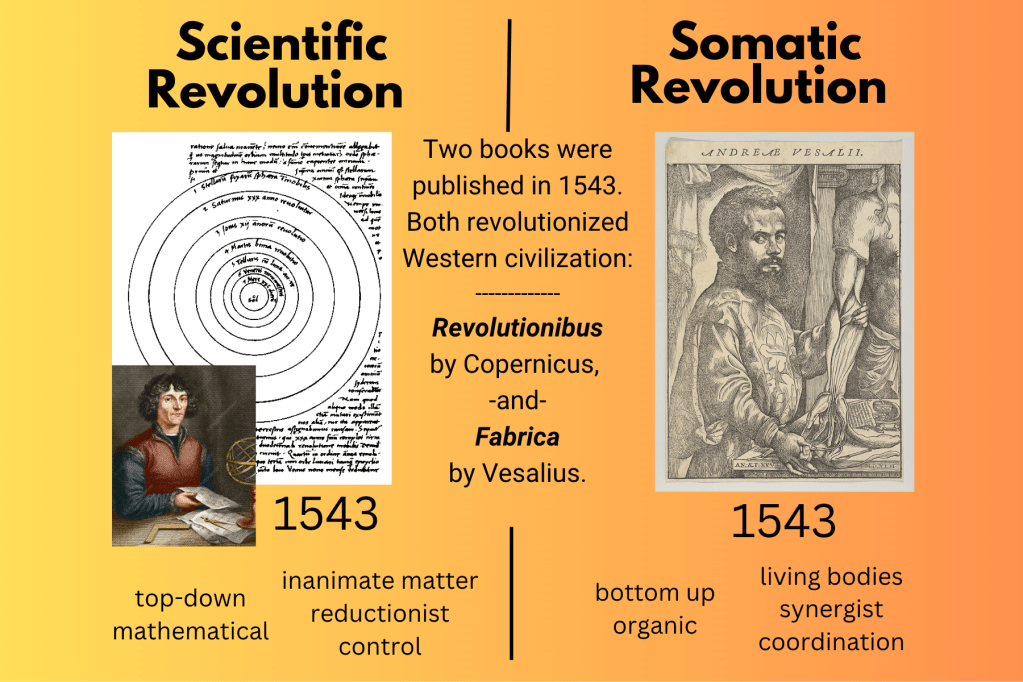
In order to understand the significance of the fascial revolution we must look at the history of modern science from its inception in 1543, with the publication of two groundbreaking books. One was mathematical and relied upon the simplification of large amounts of astronomical data, De Revolutionibus Orbium Coelestium (On the Revolutions of the Heavenly Spheres), by Copernicus. This book was not well understood or widely accepted until Galileo’s work in the following century. This text was the beginning of modern physics and mathematics, the scientific tradition that soon gained overwhelming dominance in our minds. The other text was called “De Humani Corporis Fabrica” (On the Fabric of the Human Body), by a brilliant young physician and professor of anatomy at the Unversity of Padua, Andreas Vesalius. Published in the same year each book represents a major revolution in our world view and was the basis for ensuing development in the science of non-living and living bodies, respectively.
This distinction is very important, as is the fact that there were two different traditions of the pursuit of the truth, called Natural Philosophy before it was called science and became heavily reductionist and mathematical in the late 19th century. Recognition of this fact is a major theme in current work in the field of complexity theory, whose proponents point out this distinction was well understood by the leaders of the mathematical tradition, including Newton, Maxwell and Schrödinger.
The fascia revolution is the rediscovery of the interconnectedness of life that speaks to the dangerous excesses of our reductionist and symptomatic scientific worldview. The connective tissue matrix has of necessity always been there in living organisms but because we were unaware of it we have taken a path that saw only the parts and not the whole that is essential for health and vitality. The somatic tradition of natural philosophy has always been focused on the importance of grasping the whole and not just the abstracted parts. Where Copernicus used a very simple geometric metaphor, Revolutionibus, Vesalius named his book Fabrica, in honor of the essential and much more complex weave of living organisms.
Fascia provided the fabric that holds us together and allows us to function harmoniously, but the fascia was not emphasized in Vesalius’ brilliant text. Not was it emphasized through the next 600 years of medical science and anatomical dissections. That breakthrough is ours to appreciate and foster.
 Three Bones Theory
Leave a Reply